
(Image Note: This Hero image features a high-quality professional stock photo of a happy, multi-generational blended family. In the bottom-left overlay, there is a small circular inset of Stephen Pett [https://cdn.marblism.com/yTVy1Tp6VRO.jpg], and in the bottom-right overlay, the company logo [https://cdn.marblism.com/4JWMKbJekcR.jpg].)
Let’s be honest: modern family life is rarely as simple as a 1950s sitcom. Most of us are living a version of "Yours, Mine, and Ours." We’ve got "his" kids, "her" kids, and perhaps a few "ours" kids thrown into the mix for good measure. It’s vibrant, it’s busy, and: if I’m being perfectly frank: it’s an absolute legal minefield if you don’t have the right paperwork in place.
I’m Stephen Pett, and in my years helping families navigate the complexities of estate planning, I’ve seen some wonderful success stories. But I’ve also seen the "legal mess" (as I like to call it) that occurs when people assume everything will "just work out." Spoiler alert: without a proactive plan, it rarely does.
In a blended family, you are essentially trying to balance two conflicting goals. First, you want to make sure your current spouse is looked after and can keep living the life they’re used to. Second, you want to ensure that the children from your first marriage actually receive their inheritance.
Achieving both isn’t just about being "nice": it’s about being smart.
The Nightmare Scenario: Sideways Disinheritance
This is a term we use a lot in the industry, and it sounds exactly as ominous as it is. Sideways Disinheritance is the primary reason I lose sleep on behalf of my clients.
Imagine this: You and your second spouse own a home together. You have two children from a previous marriage. You leave everything to your spouse in your Will, assuming they’ll "do the right thing" and leave a share to your kids when they pass away.
But then, life happens. Your spouse might remarry after you’re gone. Or perhaps they have a falling out with your children. Or, most commonly, they simply make a new Will leaving everything to their own biological children.
Just like that, your assets: the wealth you worked your whole life to build: have "slid" sideways out of your bloodline. Your children get nothing. Zero. Zilch. It’s a gut-wrenching outcome that happens more often than you’d think, usually because the deceased spouse didn't want to "cause a fuss" while they were alive.
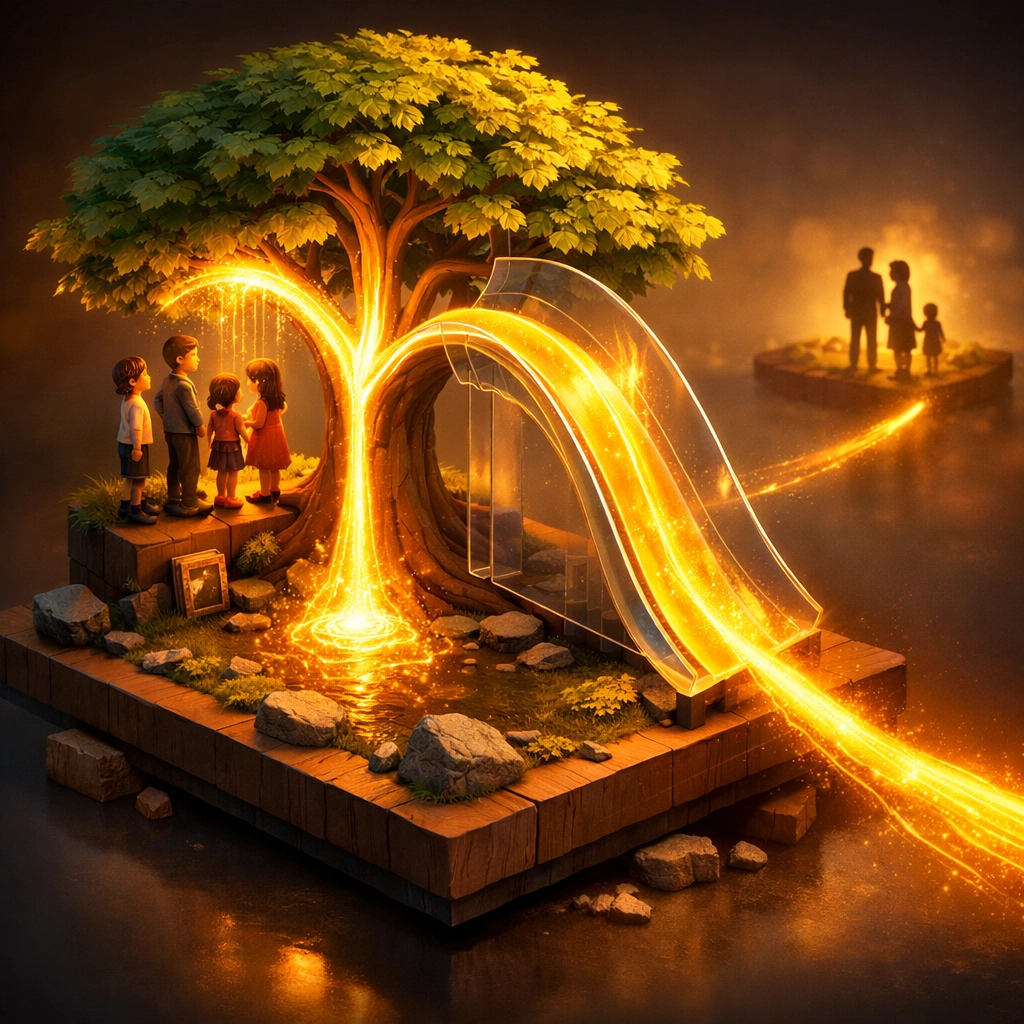
(Visual Suggestion: A conceptual graphic showing wealth moving from a parent to a spouse and then away from the original children to a different branch of a family tree.)
Why Your Current Will Might Be a Ticking Time Bomb
Many people don't realise that marriage revokes a Will. If you had a Will in place, got divorced, and then remarried, your old Will is likely now as useful as a chocolate teapot. If you haven't written a new one since your most recent wedding, you are currently "intestate."
Under the rules of intestacy, your estate follows a strict legal hierarchy that rarely accounts for the nuances of a blended family. You might think your partner is your "next of kin" and will get everything, but the reality is often more complicated and can lead to unintended consequences for your children. You can read more about the myths of next-of-kin status in our dedicated blog post here.
Even if you do have a Will, if it’s a simple "mirror Will" (where everything goes to the survivor), you are essentially handing over the "steering wheel" of your legacy to your spouse. You are trusting that they won’t change their mind, won’t get sued, and won’t need expensive care that eats up the entire inheritance. Personally, I’m wary of leaving that much to chance.
The Hero of the Piece: The Property Trust Will
If there’s one tool that solves 90% of the headaches in blended family planning, it’s the Property Trust Will.
Think of it as a "middle ground." Instead of leaving your share of the family home directly to your spouse, you leave them a "Life Interest" in it. This means they have the legal right to live in the house for the rest of their life (or until they remarry or move into care, depending on how we word it).
However: and this is the clever bit: they don't actually own your share. Your share of the house is held in a trust. When your spouse eventually passes away, your share of the house goes exactly where you wanted it to go: to your children.
Why this is a win-win:
- For your spouse: They have total security. They can’t be kicked out of their home, and they can often even sell the house and buy a smaller one using the trust funds.
- For your children: Their inheritance is "locked in." It’s protected from your spouse’s future creditors, future spouses, or even from being swallowed up by care home fees.
It’s a sensible, pragmatic solution that acknowledges the reality of modern relationships without sacrificing the future of your children.

Beyond the Bricks and Mortar: Pensions and Life Insurance
While the house is usually the biggest asset, it's not the only one. Blended families need to look at the "hidden" inheritance too.
- Beneficiary Designations: Your Will doesn’t usually control your pension or your life insurance. Those are governed by "Expression of Wish" forms held by the providers. If you haven't updated these since your first marriage, your ex-spouse might be in for a very pleasant (and totally legal) surprise when you die. (Cue distant cheering from the ex-spouse).
- Immediate Inheritance: Sometimes, it’s better to give your children a little something now. If you have a much younger second spouse, your children might be in their 60s or 70s by the time they inherit from a Property Trust. Using life insurance to provide an immediate "cash gift" to your children upon your death can help smooth over family tensions.
- Digital Assets: In 2026, our lives are digital. Who has the passwords to your crypto, your cloud storage, or your business accounts? Ensuring these are part of your plan is no longer optional.
The Conversation No One Wants to Have
I get it. Sitting down with your spouse and saying, "I love you, but I don't trust the legal system to protect my kids if you remarry a ski instructor named Fabio," is a bit awkward.
But trust me, an awkward conversation now is much better than a "contentious probate" lawsuit later. Family mediation and open dialogue are essential. When everyone knows the plan: and why the plan exists: there’s far less room for resentment. We’ve even written about how to avoid arguments over your Will, which is a must-read for anyone in a blended setup.
Don't Forget the Living Years: LPAs
While we’re talking about protecting the family, we have to mention Lasting Powers of Attorney (LPAs). If you lose capacity: perhaps through an accident or illness: who makes the decisions? Is it your new spouse? Your adult children from marriage number one?
If you haven't appointed them formally, they might end up fighting in the Court of Protection. That is a slow, expensive, and incredibly stressful process that can tear families apart. I’ve seen it happen, and it’s a "pothole" you definitely want to avoid. Check out our guide on the LPA pothole to see why being proactive is the only sensible move.
Is Your Will Outdated?
If you’ve been nodding along to this, wondering if your own setup is a bit shaky, it probably is. The laws change, tax thresholds move (or stay annoyingly frozen), and family dynamics evolve.
At The Professional Will Writer, we specialise in taking the "legal-ese" and turning it into a plan that actually works for your specific family. Whether you’re in Polegate or anywhere else in England and Wales, we’re here to help you get it sorted.

We offer a free Will review to help you identify the gaps in your current planning. If you haven't checked your documents in the last few years, you might find you're making one of the 10 common signs that your Will is outdated.
Final Thoughts
Blended families are a beautiful testament to the fact that we can build new lives and new loves. But they require a higher level of "legal hygiene" than a traditional nuclear family.
Ask yourself:
- If I died tomorrow, would my children be guaranteed a penny?
- Could my spouse be forced to sell the house to pay for care?
- Is my "Expression of Wish" form still listing my ex?
If the answer to any of those makes you nervous, it’s time to act. Don't leave your children’s inheritance to the "luck of the draw" or the goodwill of the future.
Just get in touch, and we’ll get it sorted. We’ll make sure "Yours, Mine, and Ours" stays as happy as it’s meant to be.

Ready to protect your family’s future? Contact The Professional Will Writer today for expert advice tailored to your blended family.